








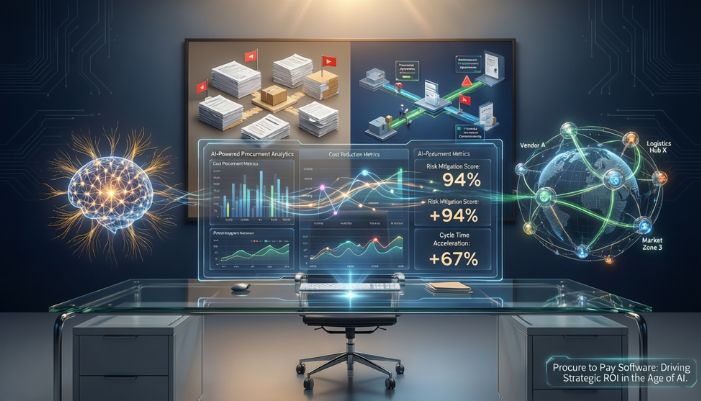
The modern business landscape is changing the world in the present scenario. Procurement through AI is the critical thing to be known to the teams of the organizations who are working under the constant pressure to reduce costs, accelerate cycles, mitigate risks, and deliver strategic value.
It is time to make a shift from the traditional procurement process to enhance the growth of the company and maximize the ROI with the help of procure to pay software.
Organizations seeking a higher ROI must consider AI in procurement for the long run in the competitive market. The market is turning smarter with Artificial Intelligence, with the changing dates on the calendar.
Dive through this write-up to unlock tricks of how AI in procurement could be helpful for organizations to get higher ROI in the modern business world.
Understanding the Convergence of AI and P2P Software
With the convergence of AI and P2P software, organizations are speeding up to update the procurement process for higher ROI.
With the order purchasing in the process of requisitions, AI in procurement is playing a pivotal role in the processing and payment of invoices. When artificial intelligence (AI), specifically machine learning (ML), natural language processing (NLP), and predictive analytics, is incorporated into P2P systems, it improves capabilities that directly contribute to return on investment.
Why Are Businesses Investing in AI-Enabled P2P?
Return on investment, or ROI, in procurement technology encompasses more than just cutting costs. Contemporary procurement executives assess return on investment (ROI) in terms of cost reduction, increased productivity, less risk exposure, improved cash flow, and strategic agility. AI enables procurement teams to directly contribute to business objectives like operational resilience and earnings growth by transforming procurement data into decisions that produce value.
Through enhanced expenditure visibility, automation, and advanced analytics, AI solutions in procurement can produce a 2-3x ROI within the first 18 months of operation, according to a recent industry analysis.
Key Ways AI Boosts ROI in Procure to Pay Software
The most significant areas where AI improves P2P systems and generates real benefits for businesses are listed below.
- Automating Low-Value Tasks to Free Up Strategic Ability
Invoice data extraction and matching: AI-driven OCR (Optical Character Recognition) and ML models are capable of accurately extracting invoice details from PDFs, emails, and scanned documents and matching them to purchase orders and goods receipts. Errors and manual intervention are significantly decreased as a result.
Intelligent process routing: Using transaction context, compliance regulations, and historical data, AI can identify the most effective approval routes.
Automatic error detection: AI can be powerful, but without human intervention, it cannot find the errors in the system that find mismatches, duplicate bills, and contract violations.
2. Enhancing Spend Visibility and Financial Control
AI increases procurement activity transparency through the real-time consolidation and analysis of massive amounts of spend data. Spending can be automatically categorized, abnormalities can be highlighted, and non-compliant purchases can be flagged using advanced analytics and machine learning.
- Organizations can use this feature to: Monitor departmental spending.
- Determine excessive spending and deviations from the budget.
- Identify unusual or rogue spending trends.
3. Optimizing Supplier Selection and Contract Performance
Procurement ROI is significantly influenced by contract management and supplier selection. By evaluating supplier performance, contract conditions, delivery dependability, pricing history, and market intelligence data to suggest the best partners, AI improves these functions.
By spotting chances for renegotiation, compliance problems, and contract expirations before they have an effect on financial results, AI also aids in contract analysis.
4. Predictive Analytics for Smarter Forecasts and Demand Planning
- Projects demand using past purchasing patterns and market trends
- Notifies procurement teams of impending cost increases or budgetary constraints.
- Models hypothetical situations to help with decision-making.
AI in procurement is heading towards the predicted demand for particular goods or services and assists teams in making the most economical purchases by examining historical spending and current market signals. Rush purchases and expensive expedited delivery costs are decreased by this proactive information.
5. Strengthening Risk Management and Compliance
Significant financial losses can result from non-compliance and supplier risk events, such as contract violations, regulatory infractions, or supply disruptions. By constantly monitoring external risk signals and procurement procedures, AI improves risk management.
AI can automatically:
- Mark transactions that pose a high risk for examination.
- Keep an eye on the financial soundness and geopolitical effects of suppliers.
Proactive mitigation, as opposed to reactive crisis management, is made possible by this ongoing monitoring.
6. Accelerating Cycle Times and Enhancing Cash Flow
One of the main factors influencing ROI in procure-to-pay is speed. AI speeds up important processes, including payment authorization, approvals, and invoice processing. Quicker cycle times result in:
- Improved early-payment discount collection
- Better handling of working capital
- Lower interest and penalty expenses
AI is becoming a cash flow enhancer irrespective of the cost-saver while allowing businesses to benefit from quicker procure to pay timescales.
7. Continuous Learning and Process Improvement
AI systems learn and get better over time, in contrast to static automation. With each cycle, machine learning models help P2P systems grow more accurate by fine-tuning their predictions based on past results.
Better anomaly detection over time, more accurate supplier rankings, and adaptive workflows that become efficient are a few examples.
Key Metrics and Benchmarks of ROI
A precise framework and pertinent measurements are needed to measure ROI from AI in procurement. Typically, organizations assess:
- Cost savings: Lower procurement expenditures as a result of improved supplier negotiations, enforced compliance, and automated cost avoidance.
- Time Savings: The number of hours saved by automating processes like approvals, purchase order creation, and invoice processing. These can be transformed into increases in production.
- Savings from risk mitigation include lower expenses for supply chain interruptions, supplier failures, and compliance fines.
- Process Efficiency: Procure-to-pay workflow cycle time improvements show how quickly procurement results are achieved.
Conclusion
AI is more than an add-on procurement technology. Slowly, it is now embarking on improving the financial performance, risk resilience, operational effectiveness, and strategic decision-making of the companies.
It is embarking on the potential journey of becoming a component of procure to pay software for higher ROI. AI in procurement is automating all types of tedious tasks while empowering advanced analytics without an intelligence risk.
For businesses looking to modernize their procurement process to maximize ROI, they must visit Procol’s official website, which provides a solid foundation for producing measurable benefits with the help of procure to pay software.